
Governance
When a data catalog earns its keep
Catalogs solve a discovery problem most companies do not have yet and an access problem every company has. Buy for the second reason, get the first free.
The Cloud Practice2 min readGovernance
Data catalogs are sold as search engines for your data, and bought, sensibly, as access control planes. Understanding which problem you are solving decides both the timing and the product.
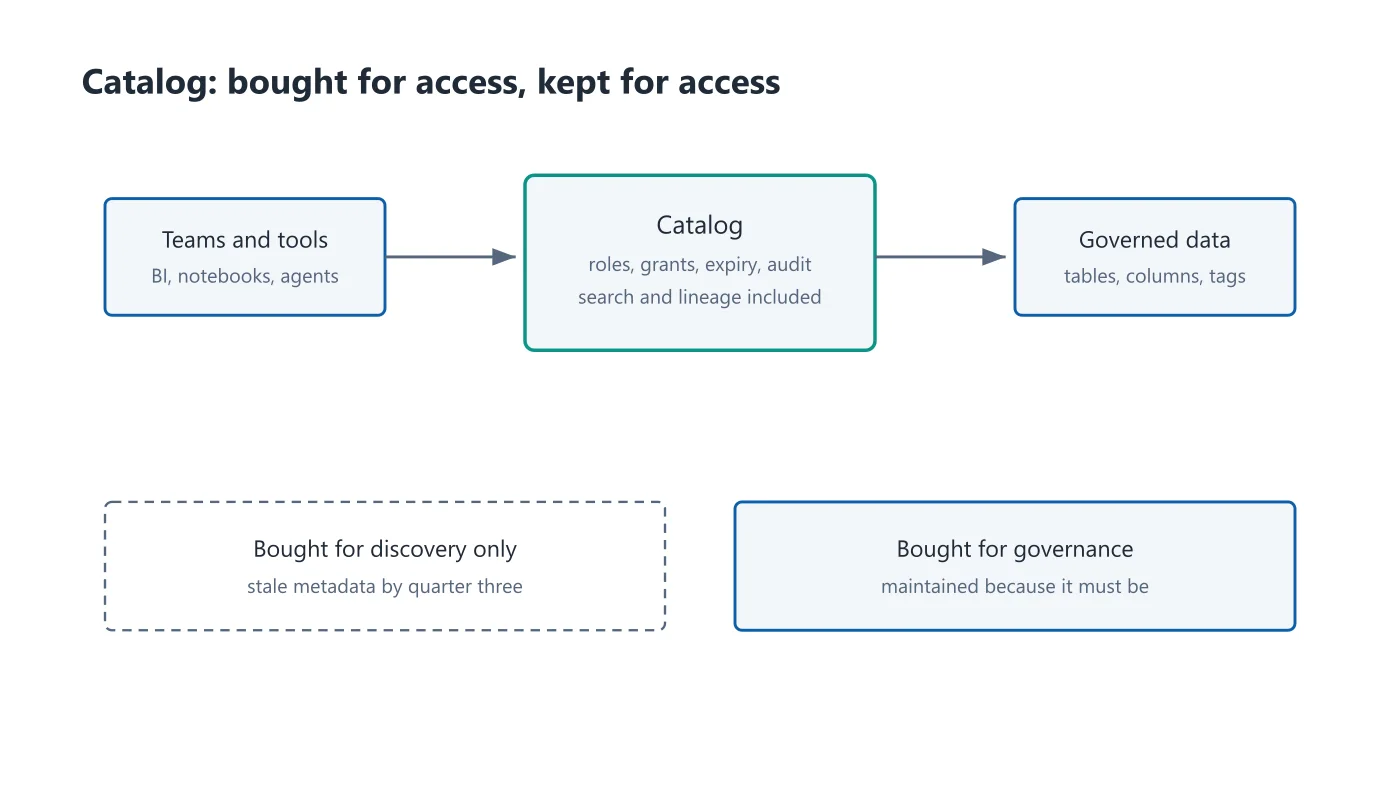
The discovery pitch arrives early; the discovery problem arrives late. Below a few hundred datasets and a handful of teams, tribal knowledge and a naming convention genuinely suffice. Buying a catalog for discovery at that size produces the industry's most common governance artifact: metadata nobody maintains describing datasets everybody already knew about.
The access problem arrives with the first external auditor or the second business unit. Who may see which columns, granted by which role, expiring when, logged where. This is the catalog problem that does not wait for scale, and the current generation treats it as the core feature: the Iceberg REST catalog ecosystem competes primarily on fine-grained access control, not on search.
Governed access is also where BI sprawl gets tamed. A public Tableau integration case study is a fair illustration of the shape: business teams querying warehouse data directly, with the platform mediating who reaches what, instead of extracts multiplying in inboxes. That mediation layer is catalog work, whatever the box on the diagram is labeled.
The buying rule we use in assessments. Adopt a catalog when you need enforced, auditable access control across more than one team or tool; choose it by governance capability and identity-provider integration; and treat search, lineage and documentation as included conveniences that will improve organically once the catalog is load- bearing. Catalogs bought for governance get maintained, because they must. Catalogs bought for discovery get abandoned, because they can.
A sequencing note for teams sold on the discovery dream anyway: documentation quality follows enforcement, never the reverse. When the catalog controls access, engineers keep table entries accurate because wrong entries page them; the descriptions and lineage that discovery needs accumulate as a side effect of the thing being load-bearing. Buy the catalog for the permission model, and the searchable knowledge base you originally wanted arrives about a year later, unbudgeted and actually maintained.