
Operations
Data SLOs that stakeholders actually understand
Freshness, completeness and accuracy promises, written in the consumer's units. How to define data service levels without importing SRE ceremony.
The Cloud Practice4 min readOperations
Ask a data team when the revenue dashboard is trustworthy and you get an architecture answer. Ask the CFO and you get a time: "by 7 a.m., Tuesday close." A data SLO is simply that time, written down, measured and owed. The ceremony that surrounds SRE-style objectives is optional; the promise is not.
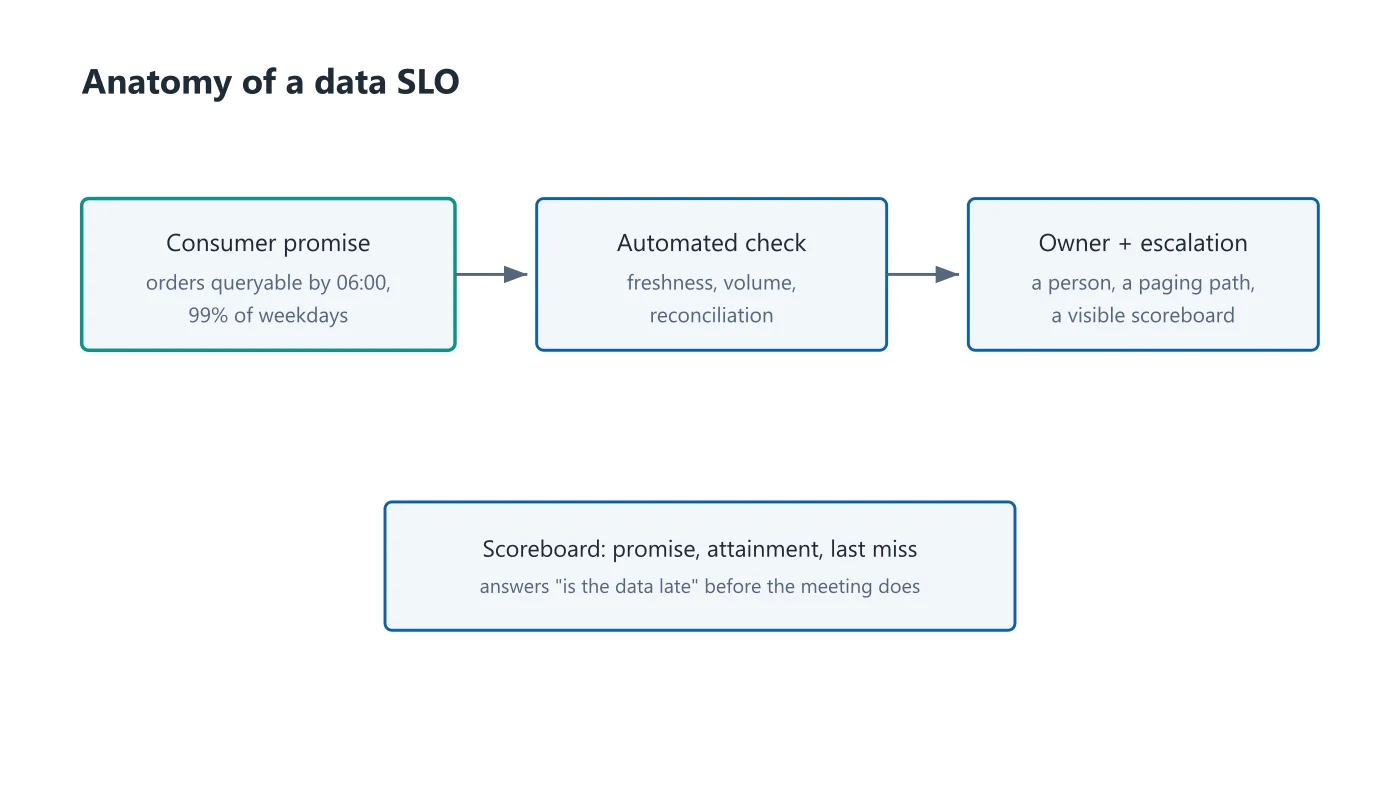
write the promise in the consumer's units
Three dimensions cover nearly everything. Freshness: "yesterday's orders are queryable by 06:00, 99% of weekdays." Completeness: "daily row volume within 5% of the trailing 30-day average, or flagged." Accuracy proxies: "reconciles with the billing system within 0.1%, checked daily." Each promise names a dataset, a threshold, a measurement window and an owner. If any of the four is missing, it is a hope, not an objective.
measure with the checks you already need
Every SLO above is enforced by the same freshness, volume and reconciliation checks that belong in any pipeline. The SLO adds two things: the threshold was negotiated with the consumer instead of invented by the engineer, and misses are visible to both parties. A quality check without a promise protects the team; a promise without a check embarrasses it.
negotiating the number
The first SLO conversation with a consumer goes one of two ways. Asked cold, everyone requests real time and 100%. Asked with a menu that shows what each tier costs, the same people choose 06:00 and 99% within minutes, because the demand was never the requirement, it was the absence of a menu. Bring three options to the meeting: what the pipeline does today, what a modest investment buys, and what the gold tier would cost in engineering quarters. Write down which one they picked and why. That record is the SLO's constitution, and it ends the annual renegotiation before it starts.
Set the first thresholds slightly looser than current performance, not tighter. The scoreboard has to earn trust by being green when things are genuinely fine, and a board that opens with three theatrical reds teaches everyone to ignore it. Tighten after a quarter of stable measurement, with the consumer in the room.
running the misses
A miss is not an apology, it is a workflow. The check that caught it pages the owning team, the scoreboard flips before the consumer notices, and the consumer gets a one-line note: what is late, why, when it lands. That note costs two minutes and buys the thing SLOs exist to create, which is the consumer's belief that silence means "on time" rather than "nobody knows". Repeated misses trigger the other half of the contract: the promise gets renegotiated or the pipeline gets the maintenance it has been arguing for. Either outcome is honest. Quietly missing a promise nobody rechecks is the only dishonest option on the table.
where to start, and where not to
Start with the three datasets that feed money decisions: the revenue dashboard, the regulatory extract, whatever the executive team reads before their Monday meeting. Three promises, three checks, one scoreboard, four weeks. Resist the program instinct to inventory every table and tier the whole estate first; that path produces a taxonomy document and no promises. SLOs spread by envy, not by mandate. When the finance pipeline has a green board and the marketing pipeline has a rumor mill, the second SLO conversation schedules itself.
Equally, do not write promises for datasets nobody consumes on a deadline. An SLO on an exploratory sandbox is ceremony, and every ceremonial promise cheapens the real ones. The test is simple: if missing the deadline would not change anyone's morning, the dataset does not need a promise, it needs the ordinary checks and no scoreboard seat.
the part that changes behavior
Publish a small scoreboard: promise, current attainment, last miss. Two effects follow within a quarter. Consumers stop escalating rumors, because the board answers "is the data late" before the meeting. And the platform team gains the only currency that buys maintenance work: a visible, agreed number that argues for fixing the flaky extract before adding the next feature. SLOs are not paperwork. They are how "the pipeline is fine" and "the dashboard is wrong" stop being the same conversation held in two rooms.
Two implementation notes from engagements. Keep the scoreboard where consumers already look, a BI tab or a pinned dashboard, not a separate tool with a separate login; adoption dies at the second password. And date every promise. "99% by 06:00, agreed 2026-03-14 with finance" reads differently from an undated rule nobody remembers negotiating, and the date is what makes the annual review a review instead of an ambush. The whole apparatus is four checks, a dashboard tab and two short meetings a year. Teams that describe SLOs as heavyweight are describing the version with the ceremony imported, and the ceremony was always optional.