
Operations
How to audit an analytics stack in two weeks
The method behind our assessment, published in full. Inventory consumers, trace lineage backwards, price every workload, interview the people on call.
The Cloud Practice1 min readOperations
This is the method inside our Data Platform Assessment, published because a team with two spare weeks can run it themselves. The order matters: start from consumers, not from infrastructure.
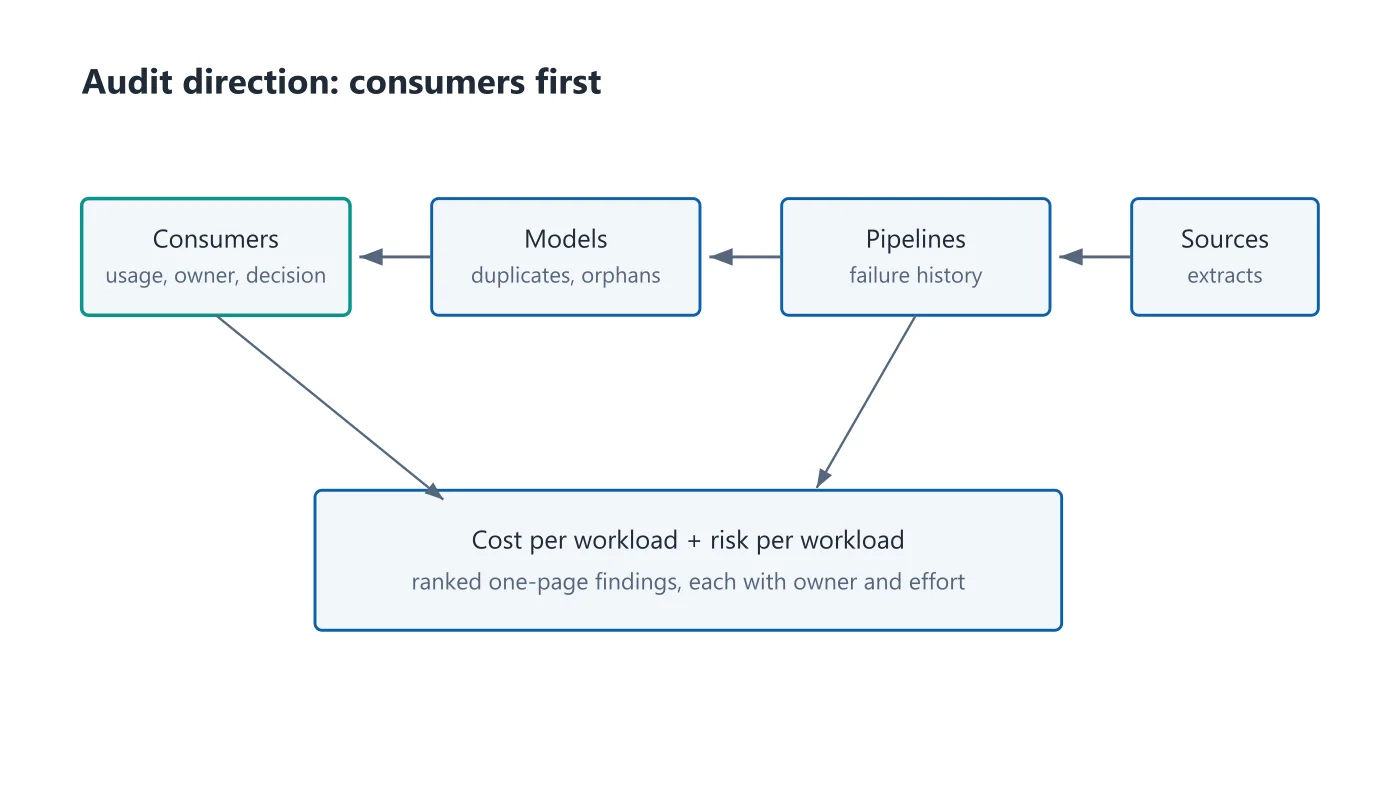
week one: what does the business actually consume
List every dashboard, report, export and model that a human or system acts on. For each: owner, audience, decision it supports, and when it was last viewed. Usage logs, not opinions; the platform tooling all exposes view counts somewhere. Expect a third of the list to be unread. That third is future savings, but do not announce funerals yet; just mark them.
Then trace the surviving consumers backward: which models feed them, which pipelines feed the models, which sources feed the pipelines. The map will contain surprises. It always does. Orphan pipelines feeding nothing, two teams computing the same table, a critical dashboard resting on a laptop cron job.
week two: what does each piece cost and risk
Price the compute per workload from the warehouse's own metering. Attach failure history: what broke in the last quarter, how it was noticed, how long recovery took. Interview whoever gets paged; fifteen minutes with the on-call tells you more than any diagram. Close by ranking every finding on two axes: money at stake and effort to fix.
the output that makes it useful
One page: top five findings, each with an owner, an effort estimate and a dollar or risk figure. The thirty-page appendix exists for credibility; the one page is what changes the quarter. If you would rather have practiced eyes run it, that is the engagement, and it is priced as two weeks, because that is what it takes.