
Operations
What happens inside a Data Platform Assessment
The two-to-three week engagement, day by day. What we need from you, what you get back, and the two outcomes we consider a success.
The Cloud Practice4 min readOperations
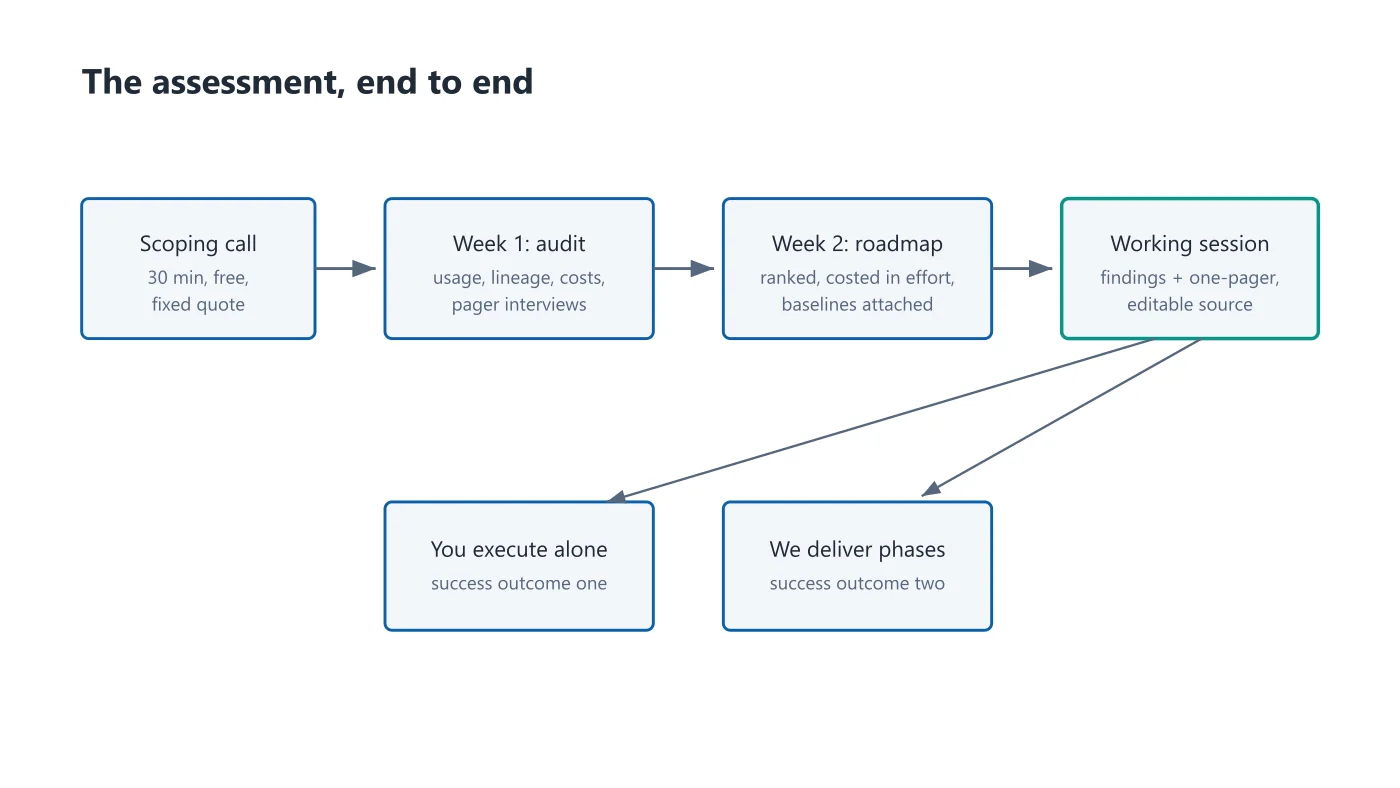
Every engagement we take starts with the same product, so this page describes it plainly. The Data Platform Assessment is two to three weeks, fixed fee, quoted after a free thirty-minute scoping call.
what we need from you
Read access to the platform (warehouse metering, orchestrator logs, BI usage stats), the current architecture picture in whatever state it exists, and interview time: thirty to forty-five minutes each with the people who run the pipelines, the loudest data consumer, and whoever owns the budget. No slide preparation; the messier the truth, the more useful the assessment.
what we do with it
Week one follows the audit method we publish: consumers inventoried against usage, lineage traced backward, costs attached per workload, failure history collected from the people who carry the pager. Week two turns findings into a ranked roadmap: each item with an effort estimate, a dependency order, a risk note, and the baseline numbers that will prove whether it worked.
what you get back
A written findings report, the one-page version an executive will actually read, and a roadmap your team can execute without us. We present it in one working session and leave editable source, not a locked PDF.
a week-by-week picture
Day one is access verification and a kickoff of under an hour. Days two through five are quiet: we read metering data, trace lineage, and hold the interviews, which are scheduled in advance so nobody's week is derailed. You will hear from us mid-engagement exactly once, with a short list of surprises so far and anything blocking us. We do not run status meetings about the assessment; the assessment is short precisely so it does not need managing.
Week two is analysis and writing. Toward its end we hold one working session with the people who will own the roadmap, walk the draft findings, and correct anything we misread. Corrections at this stage are common and welcome; an assessment that cannot survive the room's scrutiny is not finished. The final report lands within three business days of that session.
what we deliberately do not do
No shadow delivery: we do not fix things we find, even quick ones, because a diagnosis that quietly becomes billable work stops being trusted as a diagnosis. No tool resale and no "preferred partner" recommendations; if the roadmap names a product, the reasoning is in the report and the alternatives are listed with it. No interviews without consent, no access beyond read, and no data leaves your environment: findings reference queries you can rerun, not extracts we keep. And no forty-page appendix. If a finding cannot be stated in a paragraph with a number attached, we have not finished thinking about it.
what it costs and what that buys
The fee is fixed at the scoping call, based on the number of systems in scope, and does not change if the work runs long. That risk is ours. What the fee buys is independence: nobody on the engagement has a delivery quota to fill or software to place, which is the property that makes the roadmap worth executing. Clients who compare us with a free vendor assessment are comparing a diagnosis with a quote, and we encourage making that comparison explicitly.
questions we are asked at scoping
Whether two weeks is enough: yes, for the decision the assessment serves. The goal is not to document everything, it is to rank what matters and price the first three moves. Depth arrives later, inside whichever roadmap item you execute. Whether we can assess a platform mid-migration: yes, and it is often the best timing, because the findings redirect effort while redirection is still cheap. Whether the interviews can be skipped to save calendar time: no. The metering data says what the platform does; only the interviews say what it costs the people running it, and half the ranked findings in a typical report trace back to a sentence someone said in minute thirty. And whether the report can be shared with a board or an acquirer: it is yours, editable source included, share it with whomever you answer to.
the two success outcomes
Some clients hire us to deliver roadmap items; each is scoped and priced separately, small enough to stop after any phase. Others execute alone, which the roadmap is explicitly written to allow. Both count as success. The failure mode we guard against is the forty-page report that changes nothing, which is why every finding carries an owner, a number and a next step. If that sounds useful, email us a paragraph about your platform.