
Operations
Executive dashboard anti-patterns we remove most often
The five patterns that make leadership dashboards untrusted, and the repairs. None of them require new tools; all of them require deleting something.
The Cloud Practice2 min readOperations
Executive dashboards fail quietly: leadership keeps meeting, the dashboard keeps rendering, and decisions route around it through exported spreadsheets. In assessments we look for five patterns, and the repair is always subtraction.
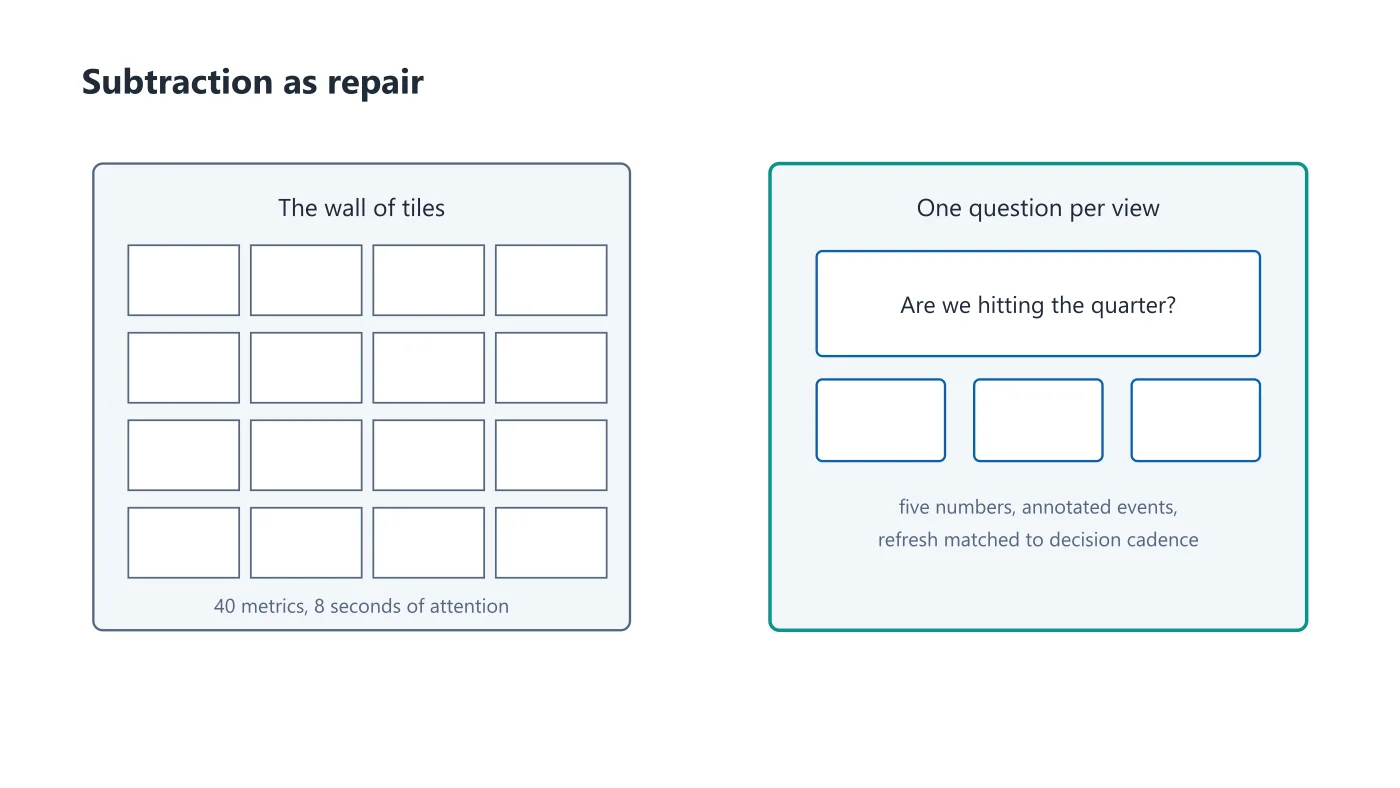
The wall of tiles. Forty metrics, no hierarchy, everything equally urgent, nothing readable in the eight seconds an executive gives a screen. Repair: one question per view ("are we hitting the quarter"), five numbers that answer it, everything else demoted to a drill-down.
The unexplained trend. A line wiggles; nobody can say why; trust exits. Repair: annotate the events that moved the line (price change, campaign, outage) as data, not as tribal memory.
The metric with three parents. Revenue per the dashboard, per finance, per the board deck. This is the metrics-layer problem wearing its most expensive costume; until the reported numbers have one definition, the dashboard is a debate prompt.
The daily refresh of a quarterly decision. Refresh cadence signaling urgency the decision does not have, at compute cost the baseline will happily itemize. Match refresh to decision cadence and label it plainly: "updated nightly, reviewed Mondays."
The dashboard nobody asked for. Built from a request relayed through three people, answering a question no one currently holds. Repair: usage logs, then a funeral.
The annotation vacuum. A number moves and the dashboard offers no reason, so the executive builds one, out loud, in a meeting, and the data team spends Tuesday disproving a theory the chart itself invited. The repair costs a text field: known causes annotated on the chart ("price change effective the 12th"), data caveats stated where the number lives rather than in a wiki nobody opens mid- meeting. An annotated wiggle is information; a bare wiggle is a prompt for fiction.
The repair sequence, when a dashboard has collected several of these patterns at once: usage logs first, to learn what is actually read; then one working session with the executive who owns the meeting the dashboard serves, to hear which three questions it must answer; then a rebuild small enough to fit those questions and nothing else. The rebuild takes days once the questions are known. Learning the questions is the part that was skipped the first time.
The most trusted executive dashboards we see are small, annotated, boring and singular, which is exactly the profile the wall of tiles was built to avoid, by someone optimizing for looking thorough over being read.