
Operations
Take the cost baseline before you change anything
Modernization without a baseline is a story, not a result. What to measure in the week before any platform work begins, and why finance will thank you.
The Cloud Practice2 min readOperations
Six months after a migration, someone senior will ask what it achieved. Teams without a baseline answer with adjectives. Teams with one answer with a table. The difference costs one week of measurement before the work starts, and it is the cheapest credibility any data program will ever buy.
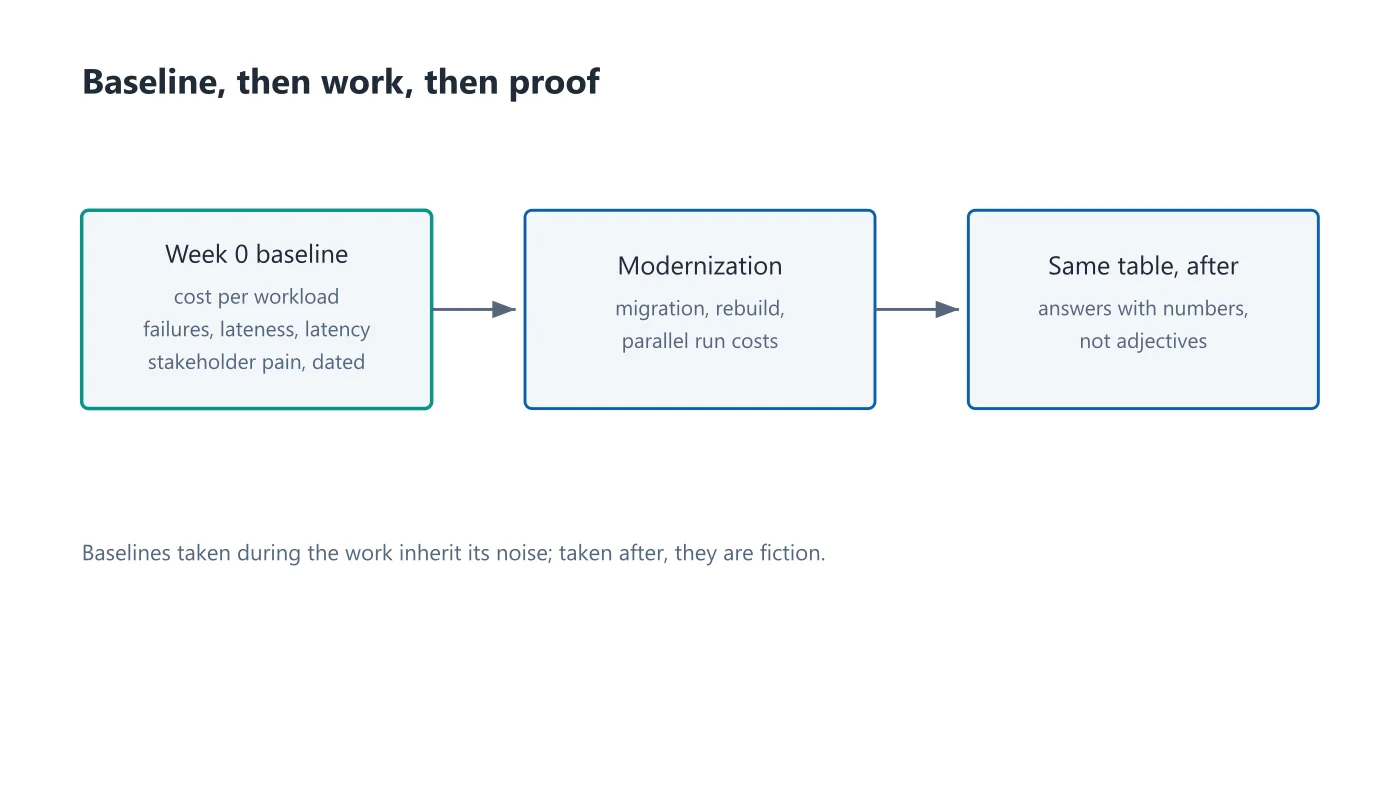
what goes in the baseline
Platform spend by workload, from the warehouse's own metering: the transformation jobs, the dashboard refreshes, the idle burn. Per-unit figures beat totals; cost per pipeline run and per dashboard refresh survive growth, while totals get argued about ("we also added three teams"). Alongside cost, capture the operational numbers the migration promises to improve: pipeline failure count per month, mean recovery time, data delivery lateness against its promised schedule, and the two or three query latencies stakeholders actually complain about.
the part everyone skips
Write down the current pain in stakeholder words, dated. "Finance waits until Wednesday for Monday's numbers." "Marketing exports to spreadsheets because the dashboard times out." Post-migration, these sentences either changed or they did not, and no dashboard of infra metrics substitutes for them.
why this is first, not parallel
Baselines taken during a migration inherit the migration's noise, and baselines taken after are fiction. The audit method produces most of these numbers as a side effect, which is one reason we insist the assessment precedes the roadmap: nobody should approve a modernization whose success will be unmeasurable by design.
A baseline also protects the team in the other direction. When the new platform costs more in month one (it usually does, parallel running is real), the baseline is what shows the curve bending by month four.
The mechanics are deliberately small: one shared document, one owner, a dated snapshot per number, and the query or export that produced it saved alongside, so the post-migration comparison reruns the same measurement instead of a similar one. Similar measurements are how migrations get declared successful. We have watched a warehouse migration claim a 40% cost win that was, on rerun with the original query, a change in what got counted. The baseline document exists to make that mistake impossible to make politely.